tick.linear_model.ModelLinReg
- class tick.linear_model.ModelLinReg(fit_intercept: bool = True, n_threads: int = 1)[source]
Least-squares loss for linear regression. This class gives first order information (gradient and loss) for this model and can be passed to any solver through the solver’s
set_modelmethod.Given training data \((x_i, y_i) \in \mathbb R^d \times \mathbb R\) for \(i=1, \ldots, n\), this model considers a goodness-of-fit
\[f(w, b) = \frac 1n \sum_{i=1}^n \ell(y_i, b + x_i^\top w),\]where \(w \in \mathbb R^d\) is a vector containing the model-weights, \(b \in \mathbb R\) is the intercept (used only whenever
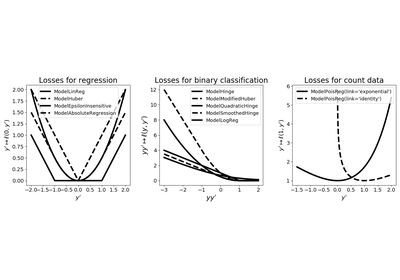
fit_intercept=True) and \(\ell : \mathbb R^2 \rightarrow \mathbb R\) is the loss given by\[\ell(y, y') = \frac 12 (y - y')^2\]for \(y, y' \in \mathbb R\). Data is passed to this model through the
fit(X, y)method where X is the features matrix (dense or sparse) and y is the vector of labels.- Parameters:
fit_intercept :
boolIf
True, the model uses an intercept- Attributes:
features : {
numpy.ndarray,scipy.sparse.csr_matrix}, shape=(n_samples, n_features)The features matrix, either dense or sparse
labels :
numpy.ndarray, shape=(n_samples,) (read-only)The labels vector
n_samples :
int(read-only)Number of samples
n_features :
int(read-only)Number of features
n_coeffs :
int(read-only)Total number of coefficients of the model
dtype :
{'float64', 'float32'}Type of the data arrays used.
n_threads :
int, default=1 (read-only)Number of threads used for parallel computation.
if
int <= 0: the number of threads available on the CPUotherwise the desired number of threads